Strategy
The Choice Stack: A Better Way to Clarify Where to Play and How to Win
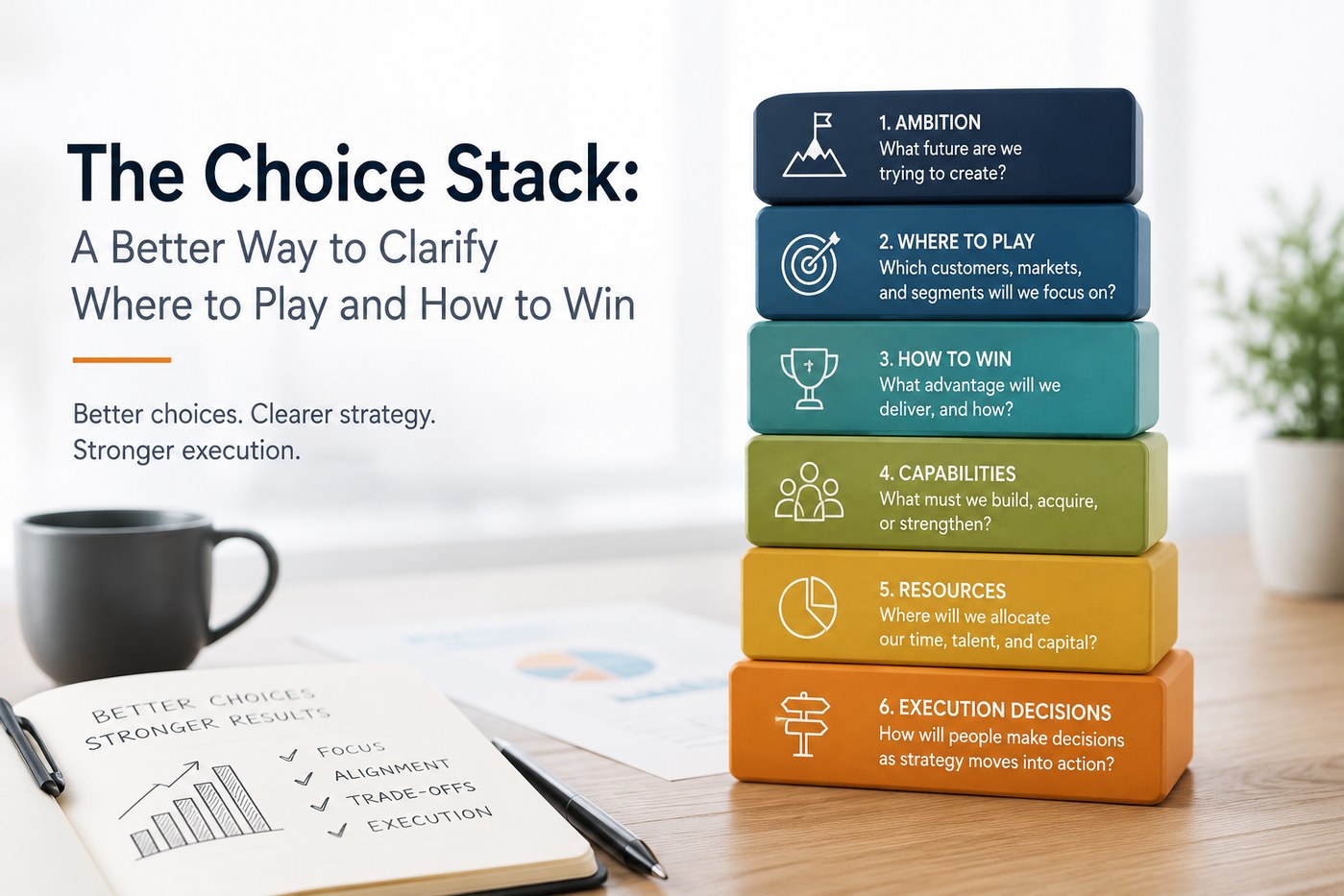
The Choice Stack helps leaders connect where-to-play, how-to-win, capability, resource, and execution choices into one coherent strategy.
Many companies do not suffer from a lack of ambition. They suffer from too many disconnected priorities. Porter's strategy guidance in Harvard Business Review emphasizes trade-offs and fit among activities, which is why a collection of individually reasonable priorities can still fail to form a coherent strategy.
The leadership team may agree that the business needs to grow, protect margins, improve customer experience, enter new markets, or become more efficient. The problem usually appears when those ambitions become budgets, hiring plans, product choices, sales targets, and operating rhythms. Strategy starts to fragment.
What Is the Choice Stack?
The Choice Stack is a structured way to connect the most important strategic decisions a business must make. Instead of treating vision, market selection, competitive advantage, capabilities, resources, and execution as separate planning topics, it puts them in sequence and shows how each decision affects the next. HBR's strategy-statement guidance is useful here because it pushes leaders to clarify objective, scope, and advantage.
The connected choices
- What is our ambition?
- Where will we play?
- How will we win?
- What capabilities must we build, acquire, or strengthen?
- Where should we allocate resources?
- How will people make decisions as the strategy moves into execution?
The value of the stack is not the list itself. The value is in the connection between the choices.
A company cannot define the right capabilities without knowing how it plans to win. A change in capabilities can also change the possible ways to win. Managers cannot execute a strategy that contradicts itself.
Why Strategy Needs More Than a Vision Statement
A vision statement can create direction, but it does not tell a team what to prioritize on Monday morning. Strategy requires boundaries. Leaders need to define which customers matter most, which markets deserve investment, which capabilities are essential, and which opportunities should be declined.
Without those boundaries, teams default to activity. They launch more initiatives, chase more segments, respond to more urgent requests, and stretch the same resources across too many priorities.
Where to Play
The where-to-play choice defines the arena. This includes decisions about customer segments, industries, geographies, channels, use cases, price points, and the problems the company will focus on. It also includes choices the company will not pursue.
This is often where strategy becomes uncomfortable. Many businesses want to keep options open, but if everything remains in scope, the organization has no real strategic boundary. Customer understanding matters here; for a useful customer-needs lens, see the Christensen Institute on Jobs to Be Done.
How to Win
Once the business defines where it will play, it must clarify how it expects to win there. The answer may involve speed, technical expertise, customer intimacy, cost position, integration capability, service quality, product performance, or a more focused business model.
The key is fit. A low-cost strategy requires different choices than a highly customized service model. A technical specialization strategy requires different investments than a broad-market scale strategy.
Capabilities and Resources
Capabilities are the things the business must be able to do well to deliver its strategy. If the strategy depends on consultative selling, the business needs the right sales talent, training, tools, and customer insight. If it depends on operational speed, it may need stronger process discipline, better systems, and clearer decision rights.
Strategy becomes real when resources move. A business can say a market is important, but if the budget, talent, leadership attention, and operating cadence do not shift, the organization will notice the gap.
This is where many strategies lose coherence. The ambition may be clear, and the market choice may sound attractive, but the organization continues funding legacy priorities at the same level. Teams then receive mixed signals. They hear that a new segment matters, but they see that staffing, capital, product attention, and executive review still favor the old center of gravity.
The Choice Stack forces that tension into the open. If a capability is essential to the chosen way to win, leaders need to decide whether to build it, buy it, partner for it, or narrow the strategy until the required capability is realistic. If a resource commitment is not available, the stack should change. Otherwise the business is not making a strategic choice; it is making a wish.
Growth Choices and Resource Implications
| Growth path | Strategic question | Resource implication |
|---|---|---|
| Core growth | Does this strengthen the business we have chosen to defend and extend? | Prioritize execution, customer retention, sales effectiveness, and operating leverage. |
| Market adjacency | Does this take our capabilities to a customer or market with similar needs? | Fund customer research, market testing, and focused pilots. |
| Product adjacency | Does this create a related offer we can credibly deliver? | Invest in capability fit, concept validation, and business model design. |
| Disruptive potential | Is the upside large enough to justify uncertainty? | Use disciplined learning milestones rather than treating the idea as a mature business. |
The table matters because different growth paths require different resource logic. Core growth, market adjacency, product adjacency, and disruptive potential should not be governed as if they carry the same uncertainty, pace, or evidence requirement.
Core growth often benefits from execution discipline. The company already understands the customer, the offer, and the operating model, so the resource question is usually about focus, sales effectiveness, retention, process leverage, or capacity. Market adjacency requires more customer discovery because the company is carrying an existing capability into a new arena. Product adjacency raises a different question: can the company credibly deliver the new offer without weakening the system that made the core business work?
Disruptive potential is different again. It may justify investment, but it should not be managed like a mature business with predictable returns. It needs learning milestones, explicit assumptions, and decision points that help leaders decide whether to continue, adapt, or stop. The Choice Stack helps leaders separate those logics instead of forcing every growth idea into the same review process.
Execution and Decision Systems
A strategy is only useful if it improves decisions below the executive level. Sales teams decide which prospects to pursue. Operations leaders decide which service levels to protect. Product and service teams decide which customer problems deserve attention. Finance leaders decide which investments deserve funding.
If the strategy does not give these people a clear decision logic, execution slows down. Teams wait for approval. Functions interpret priorities differently. People continue old habits because the new boundaries were never translated into working rules.
Execution also requires learning discipline. Harvard Business Review's "Why Start-ups Fail" explains how start-ups can fail when teams do not learn from evidence quickly enough.
A useful Choice Stack therefore needs to show up in management routines. It should influence how initiatives are approved, how trade-offs are escalated, how budgets are reviewed, how managers explain priorities, and how teams decide whether a request fits the strategy. Without that operating translation, the stack remains an executive artifact rather than a working system.
The goal is not to centralize every decision. It is to give people enough strategic logic to decide well without repeatedly waiting for senior approval. A manager should be able to ask: does this customer fit the chosen arena, does this work strengthen the way we intend to win, and does this use of resources build the capabilities we said mattered?
Common Signs Choices Are Not Stacked
- Leaders agree on growth goals but disagree on which markets matter most.
- Every initiative sounds important, even when resources are limited.
- Sales, operations, finance, and product teams define priorities differently.
- The company says it wants focus but continues to fund too many small bets.
- Managers wait for executive approval because trade-offs are unclear.
- Capabilities are funded after the strategy is announced rather than designed into it.
Another warning sign is language that sounds strategic but cannot guide a decision. Phrases like customer-centric, innovative, premium, efficient, or market-leading may be directionally useful, but they do not tell a team which customer to prioritize, which opportunity to decline, or which capability deserves investment this quarter. The Choice Stack pushes those words into more concrete choices.
It also helps leaders see when the organization is trying to win in incompatible ways. A company may say it wants a highly customized offer while also demanding a low-cost operating model. It may say it wants to focus on enterprise customers while allocating most product energy to small-account requests. It may say a new market is strategic while keeping its strongest talent on legacy work. These contradictions are not always visible in a strategy document, but they become visible when the stack is examined from top to bottom.
How to Use the Choice Stack in Practice
Leaders can use the Choice Stack as a practical review tool. Start with the ambition and ask whether it is specific enough to guide trade-offs. Then examine where-to-play choices and test whether they identify real boundaries. Next, review how-to-win logic and ask whether it explains why the company should have an advantage in the chosen arena.
From there, move into capabilities and resources. Which capabilities are already strong enough? Which are missing? Which investments are protected because they are essential to the strategy? Which activities should be reduced because they no longer support the chosen direction? Finally, translate the stack into execution rules so managers know how to act when leadership is not in the room.
The strongest use of the Choice Stack is iterative. If the resource choice is impossible, revisit the ambition or the market choice. If the capability requirement is unrealistic, rethink how to win. If managers cannot apply the strategy to everyday decisions, the stack is not yet clear enough.
The Choice Stack Makes Strategy Easier to Use
The Choice Stack does not make strategy easy. Leaders still have to make trade-offs, test assumptions, and decide what not to do. But it makes strategy easier to use.
It gives the leadership team a common structure for discussing choices. It connects ambition to markets, markets to advantage, advantage to capabilities, capabilities to resources, and resources to execution. Most importantly, it helps people across the business understand how their decisions support the company’s direction.
Clearer choices create clearer boundaries. Clearer boundaries improve focus. Better focus helps teams use time, capital, and talent more effectively.